Course Summary
This course provides participants with knowledge and practical strategies to understand, support, and celebrate neurodiversity.
Participants will explore the meaning of neurodiversity and neurodivergence, examine key conditions such as autism, ADHD, dyslexia, dyscalculia, and dyspraxia, and learn approaches that foster inclusion and acceptance across educational and workplace settings.
By the end of this training course, participants will be able to confidently recognise and value neurodivergence, implement inclusive policies, and adopt trauma-informed strategies where required that reduce risk and promote resilience.
This training empowers organisations to move beyond compliance, fostering environments where neurodivergent individuals can thrive and contribute their unique strengths.
Course Learning Outcomes
Below are the main topics covered in this course, expand each one to see the criteria.
- 1.1Explain the meaning of neurotypical, neurodiversity, neurodivergent and neuroplasticity
- 1.2Consider misperceptions in understanding neurodiversity
- 1.3Define the principles of promoting neurodiversity through inclusion and policy
- 2.1Identify different types of neurodivergence including autism, ADHD, dyslexia, dyscalculia and dyspraxia
- 2.2Identify skills and qualities in autism, ADHD, dyslexia, dyscalculia and dyspraxia
- 2.3Describe ways of supporting neurodivergent people including workplace and educational settings
- 2.4Consider adaptations which can be made to create inclusion
- 3.1Explain theories of neurodivergence and developmental delay
- 3.2Explain theories of neurodivergence and the impact of adverse early life experiences and trauma
- 3.3Explain the meaning of latent vulnerability
- 3.4Identify potential causes of latent vulnerability
- 3.5Explain ways of supporting neurodivergent people from a trauma informed approach
- 4.1Confirm the six principles strategy of promoting neurodivergence
- 4.2Identify key principles of maintaining a positive approach to neurodivergence
- 4.3Explain the meaning and importance of a ‘whole organisation approach’ to neurodiversity
Who is this course for?
This Neurodiversity training course is applicable to all sectors but this course is tailored for professionals working within social care or education
Duration
1 day course - we can be flexible on start and finish times to suit your needs such as school run friendly times.
Availability
This neurodivergence training course is offered in two delivery formats:
- Remote Online: Led by a live tutor via Zoom or Microsoft Teams, allowing participants to join remotely. (Also known as virtual classroom training)
- Face-to-Face: Delivered in person at your location or a venue you arrange. (Also referred to as on-site training)
View a comparison of Remote and in-person face to face training .
Complete our quick enquiry form for a price and available dates.
Certification
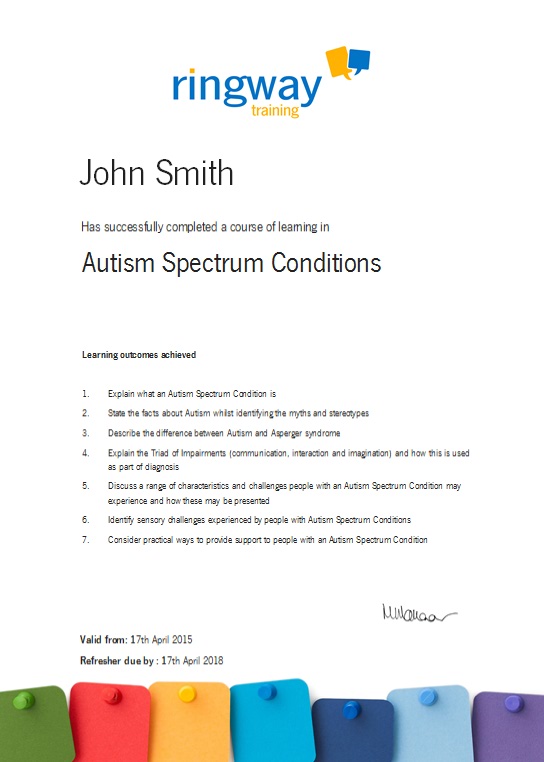
Each learner completing this course will receive a digital (PDF) certificate of learning.
Accreditation
The course contents are accredited by the Open College Network (OCN) Credit4Learning as a Level 3 course.
Choose the learning environment that works best for you: our expert-led training is offered in two convenient formats - remote tutor led online or in person face to face.
Flexible start and finish times to suit you. Contact us for available dates.
The course contents are accredited by the Open College Network (OCN) Credit4Learning as a Level 3 course.
Get a Price or more information...
Just fill in this quick form and we will email you an all inclusive price, don't worry we will never add you to any marketing lists - promise. If you want more information first thats great - just get in touch
Clear pricing
We ask for location (for face to face training) and approximate numbers because we include any expenses in the quotes we give so you get one clear price - no surprise added extras
More Information?
If you have any questions, want more information or interested in a series of courses please contact us
Contact Us